Preparing Tomorrow's Heroes Through Immersive Emergency Response Training
From instructor config to learner telemetry — the name tells you how the training works and what it prepares you for.
HERO-PREP
Select Viewport
Two ways in, then the evidence in three parts: an emergency training programme reimagined for QS Reimagine Education.
Introductory Video
Introductory video on the HTI Clinical Education programme (YouTube).
Phoenix News — HTI Clinical Education feature
News feature on the HTI Clinical Education programme, featuring HERO-PREP (May 2026).
001
Game Flow
One six-minute drill, end to end — instructor config, survey, ready check, rehearsal and post-session review.
002
Debriefing
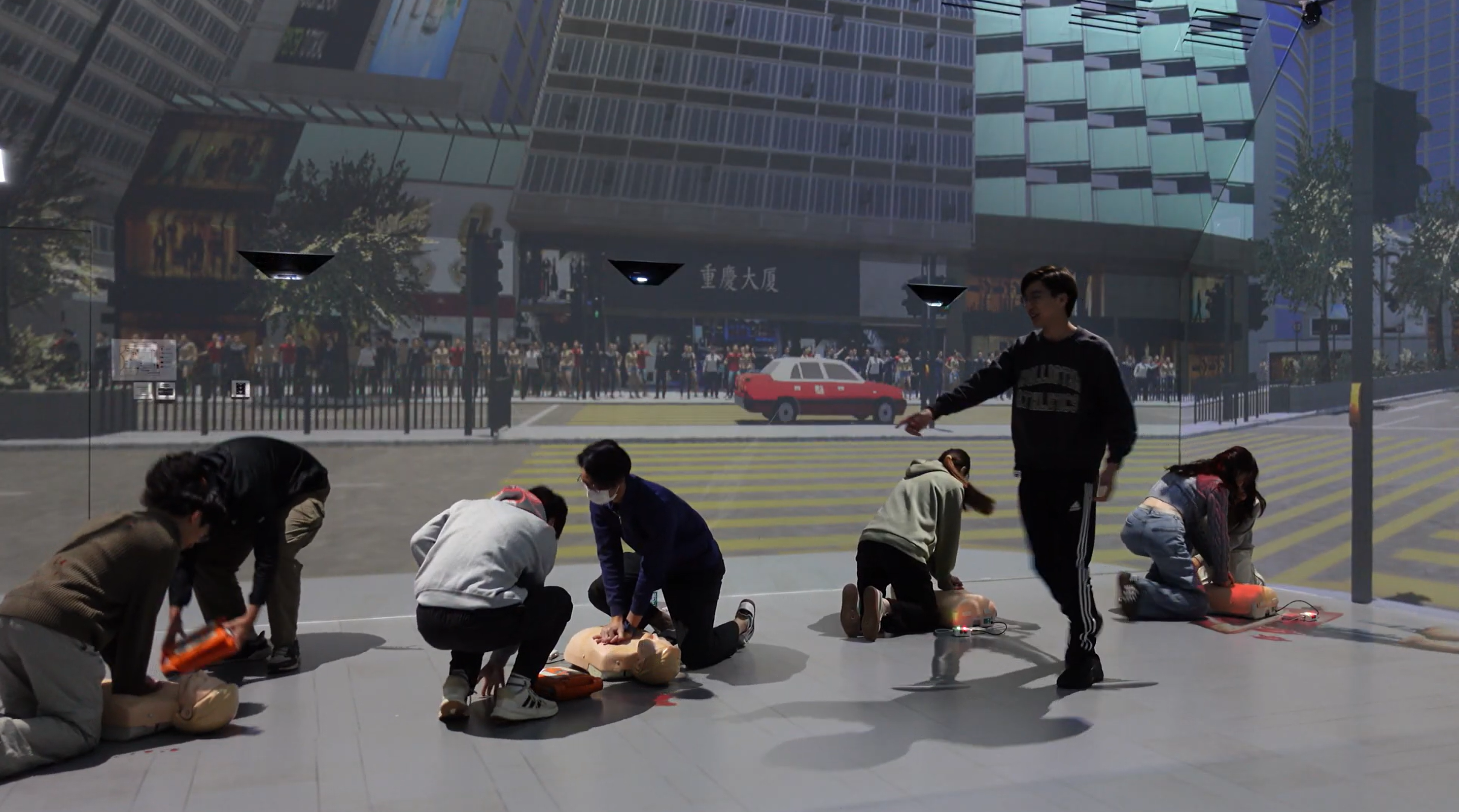
The immersive result scene — learners read their live performance off the projection wall and turn the drill into reflection.
Area I
Innovation
The HiVE six-sided room and the AI call-for-help platform — no headsets, one space, every scenario.
Area II
Impact
174 students across two Hong Kong universities — confidence, CPR-skill gains and learner experience, verified against raw questionnaire data.
Area III
Depth
How the scene scales — the setting, the scenario library on six projection walls, and a transferable framework.
Game Flow
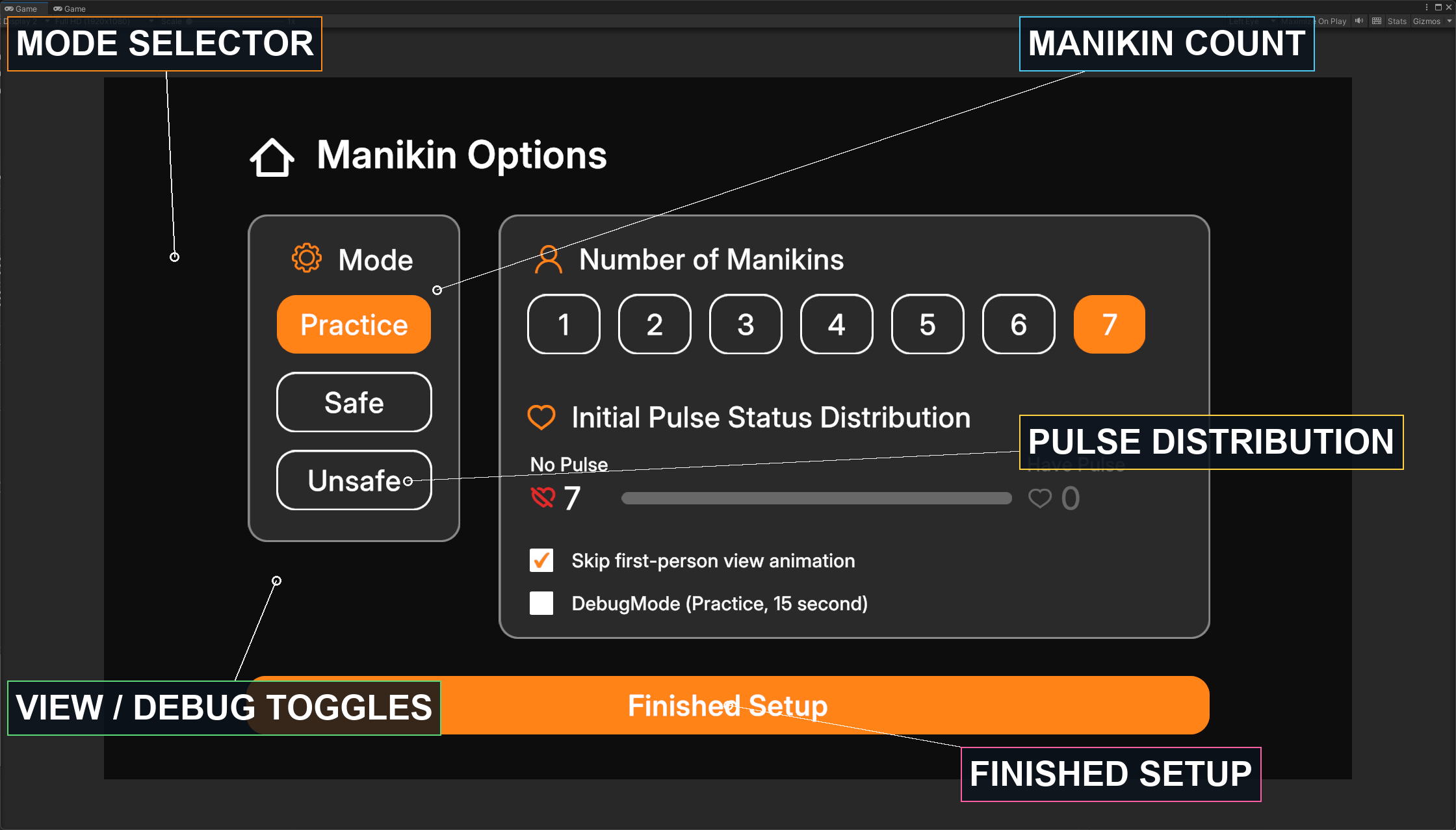
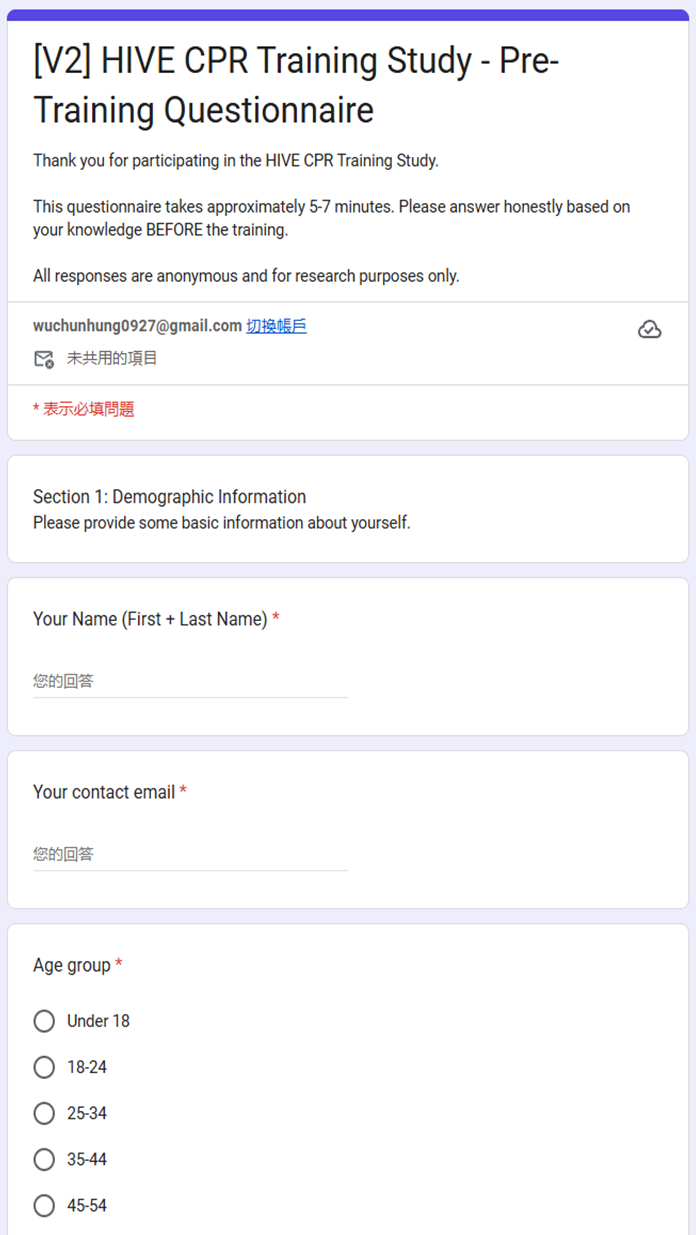
One six-minute drill, end to end. An instructor-configured scenario moves students through survey, readiness, rehearsal with a 999 call, and debrief — with real stress built in.
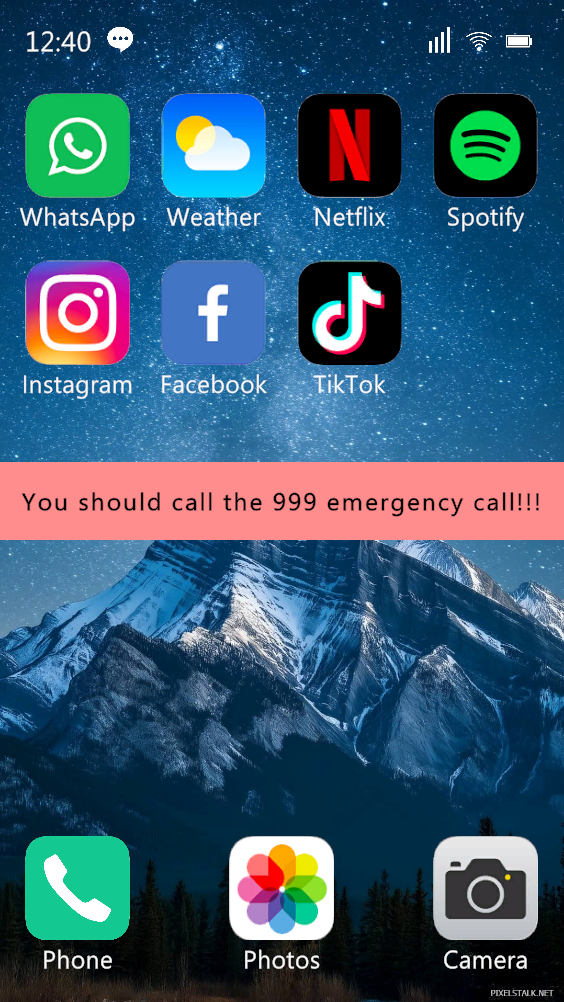
AI operator, accident scene, one-tap emergency call
Act IV
CPR + AED / POST-SESSION
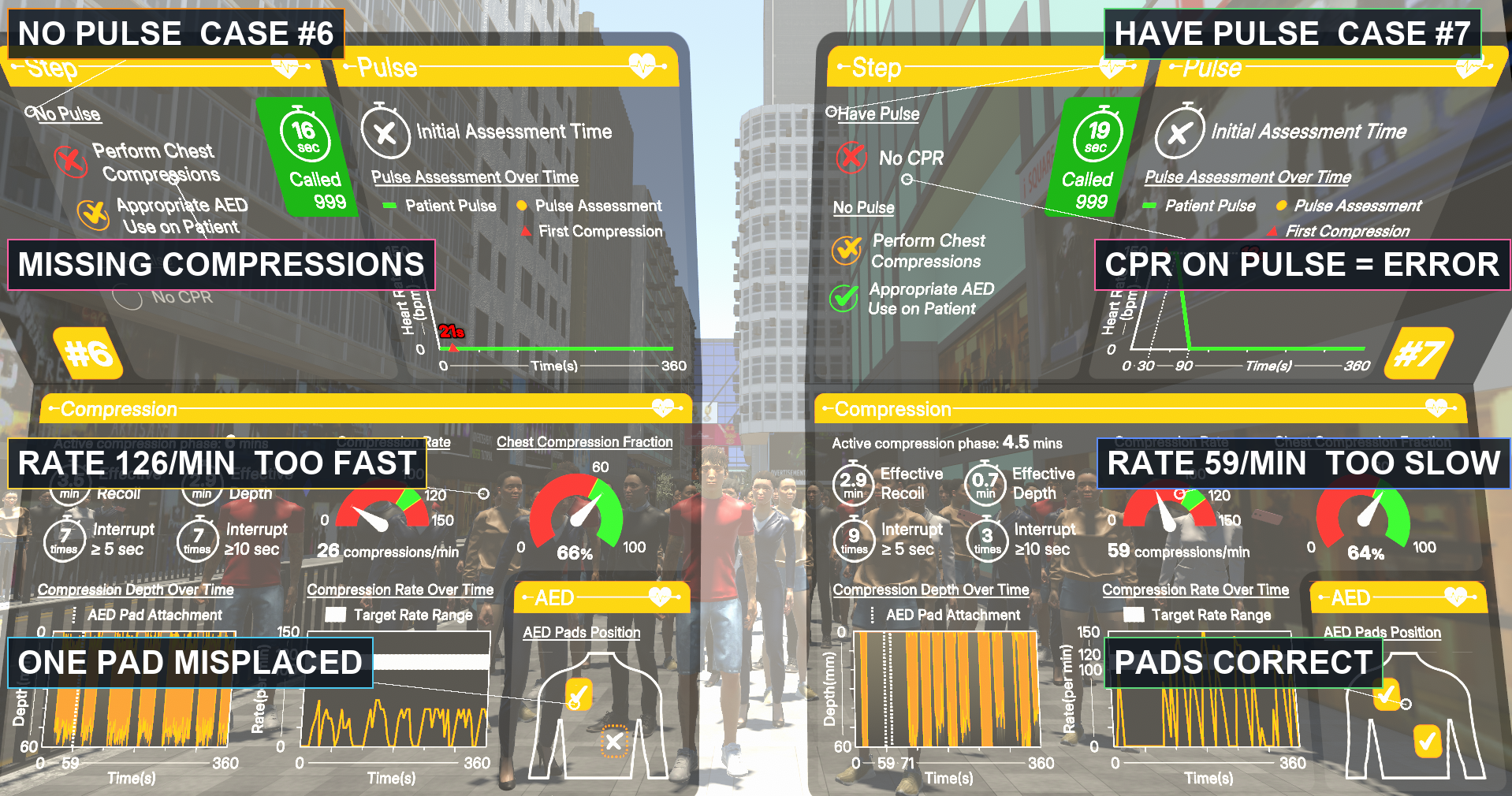
Case #6 vs #7: step, pulse, compression and AED results
Area I: Innovation
Not a game flow, but a real facility and an AI call-for-help platform. The HiVE is a six-sided immersive room without headsets; a generative-AI operator trains the 999 call under pressure.
The HiVE six-sided room and the AI call-for-help platform — no headsets, one space, every scenario.
HiVE
SIX-SIDED ROOM
Projection on every surface, no headsets — students move and coordinate freely.
AI CALL
999 SIMULATION
An AI operator responds dynamically, training communication under pressure.
AI CALL
LIVE EXCHANGE
Each call is a real conversation — the link between knowing and acting.
DRILL
SELF-ORGANISING
With no assigned roles, students decide who acts, on whom, and how.
PEOPLE
PEER TUTORS
A peer tutor as casualty/bystander — the human dimension no manikin replicates.
DEBRIEF
METRICS WALL
After the drill, performance projects on the walls to drive the debrief.
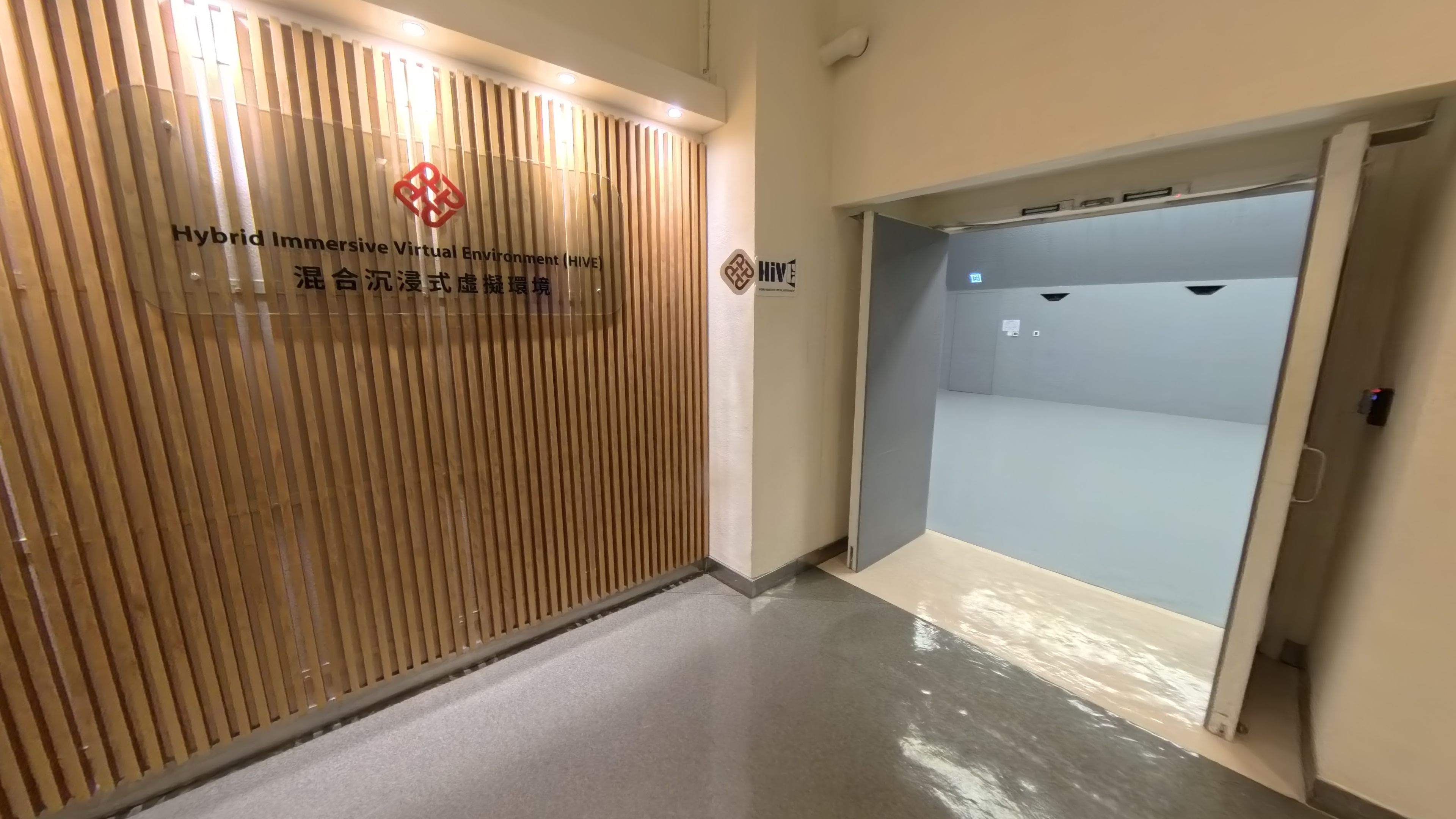
The HiVE facility
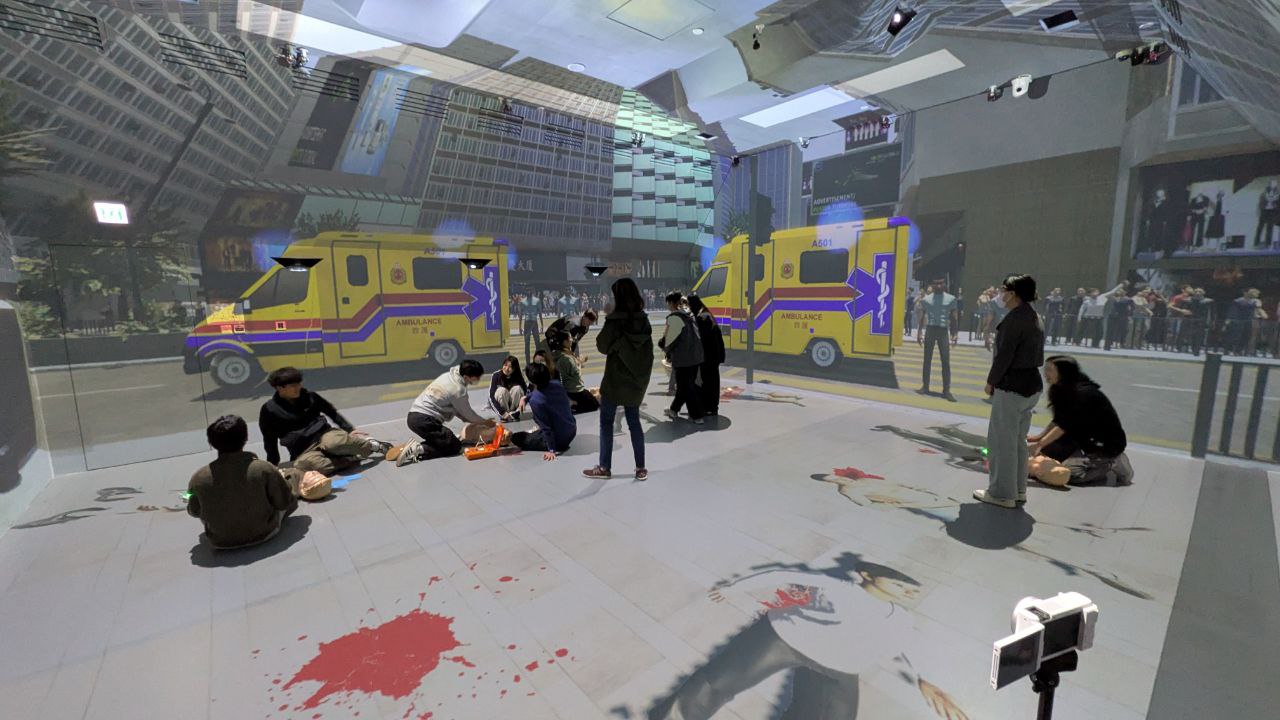
A six-sided immersive room with projection on every surface — scenarios are realised in full 360°, with no headsets and no rebuilding of the space between drills. One room hosts them all.
The AI call-for-help platform
A web-based simulation places a generative-AI emergency operator on the line. It responds dynamically to each learner's 999 call, rehearsing the communication that turns knowing into acting — the link most training forgets.
Two distinct immersive scenarios
HERO-PREP operates across two fully realised scenes, each selectable by training objective: a traffic accident on a busy Hong Kong street, and a warehouse trauma-and-fire. Patient conditions — cardiac arrest, respiratory arrest, and physical trauma — are configurable within each, so one system trains multiple clinical presentations without rebuilding the space. The six-minute drill ends when the virtual ambulance arrives, mirroring Hong Kong's average emergency response time from the moment a call is made — temporal as well as physical realism.
Human + machine, together
Peer tutors act as casualties and bystanders; the AI handles the call. The facility supplies the realism, the platform supplies the conversation — integrated, repeatable, and scalable to a full cohort.
Source: QS26 Innovation & Impact evidence — HERO-PREP Innovation Comparison & Impact summaries (n=174, two institutions). Contrasts traditional manikin, headset VR, and HERO-PREP mixed-reality training.
Area II: Impact
174 students from two Hong Kong universities. Every figure is verified against raw questionnaire data.
One drill. 174 learners. The figures below are real outcomes, verified from pre/post questionnaire data — not samples.
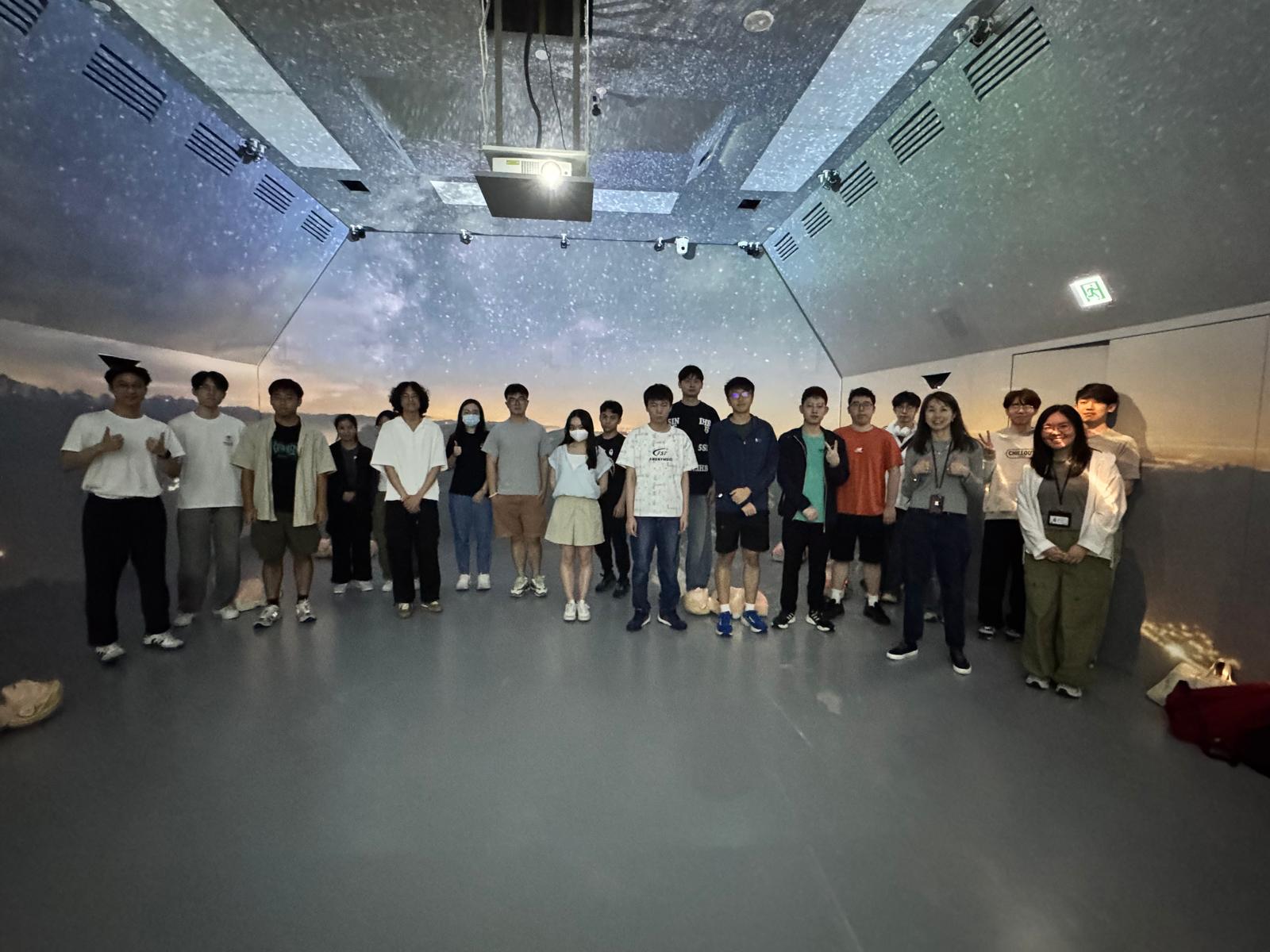
The 174-student cohort across two institutions — the people behind every figure in this chapter.
Impact
DEBRIEF WALL
Learners read their live performance off the projection wall.
Impact
MIXED COHORT
Students from different disciplines training together.
Impact
174 LEARNERS
The people behind every figure above.
Confidence Before → After (0–100 scale)
Cohort
Before
After
Gain
PolyU (n=121)
76.2
82.4
+6.2
HKU (n=53)
52.4
67.6
+15.2
Combined (n=174)
69.0
77.9
+8.7
All cohorts improved significantly after a single drill. HKU (no health-science background) gained most — impact is not limited to clinically-familiar learners. 97% of PolyU students were already CPR-trained, so gains sit on top of prior knowledge.
Top 7 CPR Skills Improved (ERC-aligned)
Skill
Before
After
Gain
Assess breathing & agonal respirations
69.5
80.7
+11.2
Open airway (best manoeuvre)
72.8
82.9
+10.1
Alert emergency services & start CPR
73.1
82.3
+9.2
Perform CPR to ERC guidelines
71.7
80.5
+8.8
Keep interruptions minimal
75.7
83.8
+8.1
Post-shock actions without hesitation
77.1
83.6
+6.5
Deliver safe shock with commands
77.5
83.8
+6.3
19 of 20 CPR skills improved significantly (avg +5.9 pts). Largest gains are in areas manikin training struggles to teach: scene assessment, airway, and alerting services.
Willingness to Act (real-world readiness)
Attitude measure
Finding
Willingness to help a stranger — change
Increased significantly (combined, n=174)
Students whose willingness increased
1 in 4 (PolyU, individual level)
Students with no change
60.3% (most already willing — ceiling effect)
Bystanders hesitate not from lack of knowledge but because real emergencies feel overwhelming. One drill already turns hesitation into readiness — the shift among those not already willing is the meaningful finding.
Learner Experience (% positive)
Measure
Rating
% Positive
Debriefing helped me reflect
4.35 / 5
87%
Helps me learn more effectively
4.23 / 5
85%
HERO-PREP useful for CPR training
4.21 / 5
84%
Intent to continue using
4.03 / 5
81%
Sense of presence
3.93 / 5
79%
Overall simulation design
4.16 / 5
83%
Enjoyed the experience
7.0 / 9
89%
No or minimal dizziness
—
73%
8 of 9 students enjoyed the experience; the AI-guided debrief projected on the walls scored highest. 1 in 4 previously-hesitant PolyU students said they would now act.
Who We Trained
PolyU
HKU
Combined
Students trained
121
53
174
Background
Health sci.
None
Mixed
When trained
March 2026
2026
—
Drill sessions
12
—
—
Prior CPR training
97%
—
—
Cross-institutional, cross-disciplinary reach tests whether impact extends beyond the original audience — a central programme claim.
Area III: Depth
More than headcount: more scenarios, more realism, sustained evaluation, and a model community organisations can run.
The HiVE room, projection-wall scenarios, and the emergency-call simulation that trains communication under pressure.
THE SETTING
HiVE
A six-sided immersive space hosting every scenario without rebuilding the environment.
SCENARIO 01
TRAFFIC ACCIDENT
A Hong Kong traffic-accident drill realised across all six projection surfaces.
SCENARIO 02
WAREHOUSE
Trauma-and-fire drill. Rehearsed without headsets.
SCENARIO 03
CONSTRUCTION SITE
One scenario library extending clinical presentations on the same hardware.
Debriefing
Where the drill becomes learning. The post-session scene that closes every run.
.jpg)
.png)
.png)
.jpg)
.jpg)
.jpg)
.jpg)
.jpg)
.jpg)